Thursday, May 15, 2025

HW for May 19 - Telling Stories about Ecology (anthology, pp. 251-258)

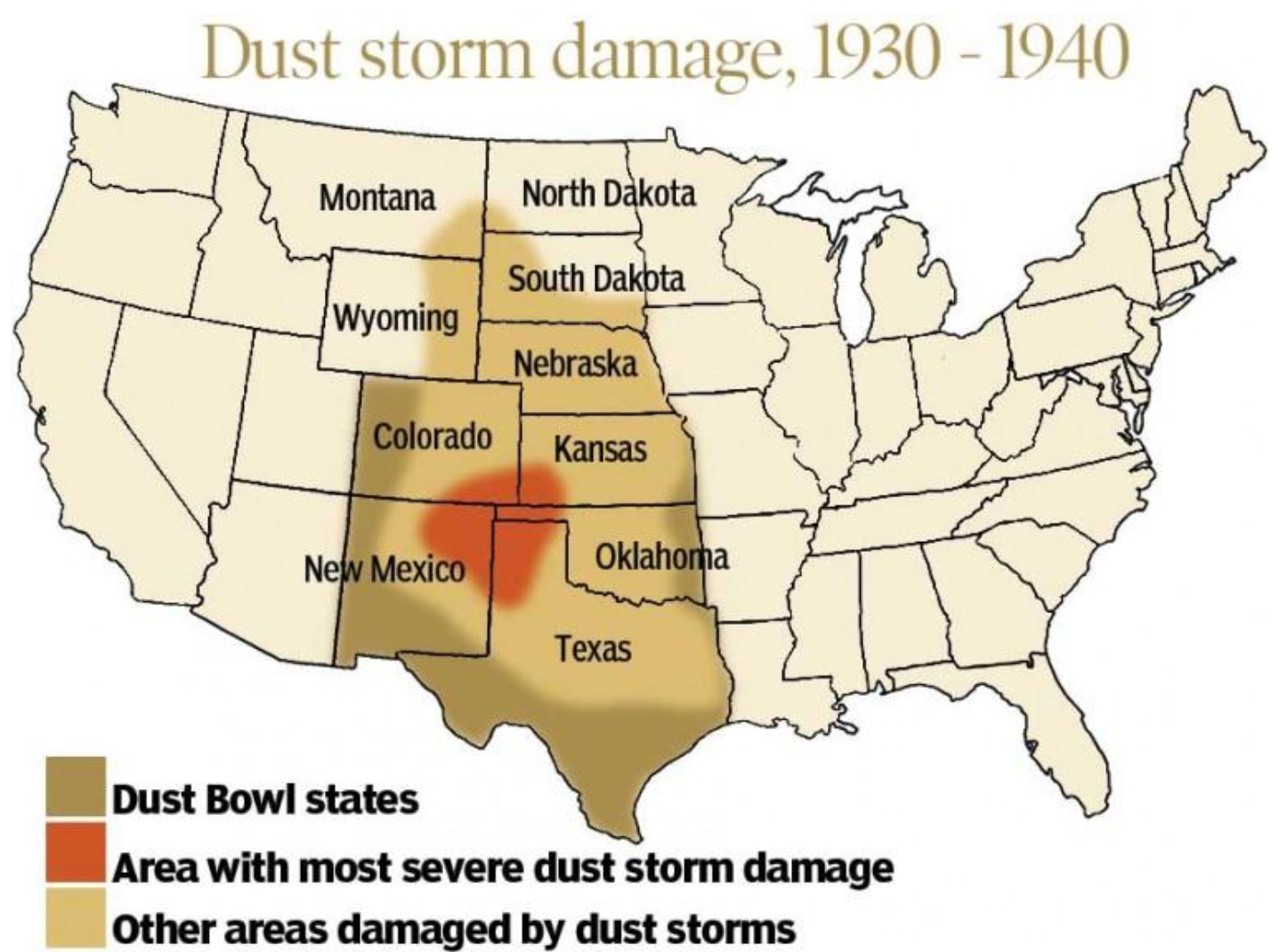
 In the article "Telling Stories about Ecology", William Cronon commnents on the history of "the Plains' States" (included by Joel Garreau mostly in the "Breadbasket" region, but also in "the empty quarter"), zooming in the episode of "the Dust Bowl" in the 1930s and arguing that such a history can be told in basically two different plotlines: the progressive and the tragic. Answer to either:

- How do these plots differ in terms of protagonists, opponents, human-environment relations, and progress?

- What other environmntal-geographic-human interactions have we studied in this class that can be said to have two plots, and what are the consequences of following either?


Wednesday, May 7, 2025

HW for May 7 and May 12: Comparison of texts

Answer to either or both:

1. Compare/contrast the two excertps, in light of the concepts of "border", "im/migration" and "Mexamerica" (Joel Garreau's idea, in, The Nine Nations of North America, of a cultural region ecompassing the American Southwest and Northern Mexico). Tip: for the first two concepts, you can peruse the 2007 edition of Keywords for American Cultural Studies in moodle).

"The most significant thing about the American frontier is, that it lies at the hither edge of free land. (...) The term is an elastic one, and, for our purpuses does not need sharp definition. (...)
       In the settlement of America we have to observe how European life entered the continent, and how America modified and developed that life and reacted on Europe. Our early history is the study of European germs developing in an American environment. Too exclusive attention has been paid by institutional students to the Germanic origins too little to the Aerican factors. The frontier is the line of most rapid and effective Americanization. The wilderness masters the colonist." (F. J. Turner, "The Significance of the Frontier in American History", anthology, p. 207).

"Borders are set up to define the places that are safe and unsafe, to distinguish us from them. A border is a dividing line, a narrwo strip along a steep edge. A borderland is a vague and undetermined place created by the emotional residue of an unnatural boundary. It is in a constant state of transition. The prohibited and forbidden are its inhabitants. (...) Gringos in the US Southwest consider the inhabitants of the borderlands transgressors, aliens - whether they possess documents or not, whethter they're Chicanos, indians or Blacks." (Gloria Anzaldúa, Borderlands / La Frontera: the New Mestiza, anthology p.227)


Sunday, April 27, 2025

HW for May 5: Ecotopia

  Watch this video with Ernest Callenbach about his visionary novel Ecotopia (1975), about the secession from the US of the eco-minded in Northern California, Oregon and Washington. Comment on two good ideas devised by the citizens of Ecotopia and/or two that would have met with serious challenges or resistance.


Tuesday, April 22, 2025

HW for April 28th: Frederick Jackson Turner, "The Significance of the Frontier in American History" (1893)

  Comment on one or both:


1. How can you relate the above picture with Jackson Turner's "thesis of the frontier"?

2. Turner codifies types of manly behavior in accordance with their mobility/progression and fixation in the land. Describe how this typification works and comment on it.

Sunday, April 20, 2025

HW for Apr 23: Leo Marx, intro to The Machine in the Garden

Answer to either (or relate them in one answer):

1. Read Leo Marx's text in pp. 194-206, and comment on how what you read added to your understanding of "pastoralism" in the United States

2  Comment on the following image, called "American Landscape" (by Charles Sheeler, 1930) in light of Leo Marx's thinking: 


Saturday, April 19, 2025

Leadership compass and environmental determinism?

 Remember basic concepts of "Cultural Geography" by Mark Paterson in our anthology, p. 26, where the author asserts that the Berkeley School in the 1920s was the starting point of the discipline and further states: 

"The influence of the Berkeley School persists in cultural geography in the US. This movement focuses on cultural interventions in transforming the surface of the earth, and is thus most interested in material culture and space. It emerged against the prevailing background of "environmental determinism" in the early twentieth-century, where human-environment relations were specified as determined by a starightforward causality." (p. 995 of the encyclopedia entry).

The word "straightforward" is key and should make us wary of simplistic attempts to define behaviours or human types according to geographical locations. One such example is perhaps the "leadership compass" positied by some corporate preachers of leadership:

                                                  in www.monitask.com

Wednesday, April 9, 2025

HW for Apr. 21: Los Angeles in relation to Yi-Fu Tuan (pp. 162-189)

Choose one or more:

1. Comment on Yi-Fu Tuan's insigths on LA and how its urban planning served the automobilie age.

2. What symbols do you connect more with LA? How are they contradictory? (perhaps, along with some remarks by Yi.Fu Tuan, this poem might help)

3. From pp. 183-188 (anthology), Yi-Fu Tuan talks about the "Skid rows" of America. What do you know about "Skid Row" in LA and how does Yi-Fu Tuan analysis help you understand it?


busy traffic in downtown los angeles at sunset - downtown los angeles streets stock pictures, royalty-free photos & images

What does an annotated bibliography look like? (for the next step of final paper - due April 18 (10 a. m.)

Annotated bibliography - where you reference and explain briefly two sources that you plan to use - ONE at least has to be a scholarly article / book or book excerpt - see an example in the second part of this post).

 Preferred citation style is that of MLA 9th 

 An annotated bibliography starts with the bibliographic details of a source (the citation) followed by a brief annotation. As with a normal reference list or bibliography, an annotated bibliography is usually arranged alphabetically according to the author’s last name. An annotated bibliography summary for each entry should not be more than 100 words. Another 100 words whould be reserved for an evaluation (why the work is useful) on the relevance of the citation for the research paper).

   Sample entries for annotated bibliography, based on the documentary

Anderson, Kelly and Allison Lirish Dean. My Brooklyn. New Day Films, 2012. Kanopy Streaming. (

 1. Jacobs, Jane. Life and Death in American Cities. 1963. Modern Library, 1992.  introduction, part II, chapter 8; part III, chap. 15)
 In this book I find especially relevant the “introduction”, chapter 8 of part II (“the need for primary mixed uses”), and chapter 15 of part III (“Unslumming and slumming”). Jacobs critiques mid-20th-century urban planning (e.g., "Radiant Garden City" models, highway expansions, and top-down renewal projects) for ignoring how cities actually function. She argues that cities thrive through organic complexity, and community involvement. Her basic tenets for city development revolve around: i)“density” (namely, amount of people – and strangers – met while walking in the city); ii) varied types of buildings (including old ones); iii) “mixed-uses” (residential, commercial, office and cultural spaces); iv) short and walkable blocks. [summary: 104 words] 

While Jacob’s chapter 8 about "mixed uses" might be fallaciously used to support gentrification processes like Brooklyn's Fulton Mall dismantlement (which served a homogeneous Black/Hispanic community), the documentary shows how this commercial area stabilized residents and fostered culture. Luxury developments may mimic mixed-use theory (starting with the argument of need for office-space) but exclude marginalized groups. Chapter 15 on "unslumming" explains the failures of clearing urban areas through abstract theories rather than reinvestment that keeps residents in place. Although Brooklyn is not properly a slum, the principle of non-displacement in the guise of urban improvement is applicable. [rationale: 96 words] 

2.  Tuan, Yi-Fu. Topophilia: A Study of Environmental Perception, Attitudes, and Values. 1974. Columbia UP, 1990. 

 In Topophilia, Tuan’s Chapter 12 ("Physical Settings and Urban Lifestyles") examines how city environments are reshaped through market forces that both vitalize and standardize urban spaces. He hints at how commercial districts may evolve from organic community hubs into sanitized, profit-driven zones. Chapter 13 ("American Cities: Symbolism, Imagery, Perception") while analysing city symbolism, also contrasts elite vs. street-level perceptions of place (subsection “the view from below”). In this way his axiologic vision includes symbolic stratification, questions of who gets to move through neigborhoods in the city, and who cares for certain neighborhoods. [summary: 92 words] 

Tuan’s observation in Topophilia concerning Harlem —"filthy yet many businesses cater to beautification" (p. 219)—parallels My Brooklyn’s Fulton Mall: a marginalized area that people condemn despite thriving Black-owned shops. Luxury redevelopment, like elite "views from above," imposes sterile order while erasing local commerce and culture. The documentary’s footage of hair salons and record-selling benches mirrors Tuan’s "view from below," revealing how communities sustain identity amid neglect. Here, "beautification" isn’t absent—it’s just deemed illegitimate by planners and so-called “developers”. [rationale: 80 words]
How to go about writing your documentary review

Your 1200-word review should critically examine and evaluate the documentary, partly using Doel’s (2010) cultural geography framework (on moodle and elsewhere in this bolog), integrating as much as possible visual and narrative structures into your discussion. 

[good news: you no longer need to write an afterwards reflection 

Here is a sample structure: 

 Introduction (150 words) Briefly introduce the documentary (title, director, subject). State its main argument/purpose and why it’s relevant to cultural geography. 

Analysis (800 words) Apply 2-4 key questions from Doel, weaving in visual/narrative techniques:
e.g., - How/why was it made? illustrate with cinematography, editing, or storytelling choices. 
- What power relationships does it reveal? illustrate with short discourse analysis of one differences in speech of two stakeholders
 - What identities does it promote? Discuss character portrayals or symbolic imagery.). 

Use 2 research sources to support your claims (cite properly and include bibliography): the in-text exploration of the quotation need not be very expanded. It can be as simple as bringing in a concept as defined in the first three introductory articles of our antholoy, pp. 3-45)

Evaluation & Recommendation (250 words) Assess the documentary’s effectiveness: Does it achieve its goals? Are its methods persuasive or problematic? Recommend (or not) based on its cultural/political value, accuracy, and relevance to geography. Suggest how it could be improved or alternative perspectives to consider.

Deadlines: Bring first draft to class on May 14th; deliver final review by June 2

Sunday, April 6, 2025

HW for April 9 - Media Literacy

 Using some aspects of the media literacy disk, compare the news on the 6th of April "Hands off Rally" in Washington DC in WUSA9 here https://www.youtube.com/watch?v=lfK7NBUs98A and in Fox News here https://www.youtube.com/watch?v=xMmo7NfT8YY

Alternatively, use these analysis indicators to speak about the documentary you have to review...


Tuesday, April 1, 2025

HW for April 7 - Jane Jacobs (anthology, pp. 133-155) and Yi-Fu Tuan (pp. 183-189)

 Answer one or both:

1. What are Jane Jacobs' beliefs about the needs for a living city? How does she see "the verities of orthodox modern city planning" (p.147) as regards those needs, and how does her introduction resonate with the themes of the documentary "My Brooklyn"?

2. Yi-Fu Tuan's subchapter, "the view from below" mostly focused on "Harlem" and then on Chicago's Skid Row, but how do some of his considerations bear on the diversity of neighbourhoods defended by Jacobs, and/or on what you noted down about the Brooklyn documentary?


Monday, March 31, 2025

HW for Apr 2: Documentary "My Brooklyn" (2012)

To assess the documentary, choose one or two of these questions that should be posed in relation to "texts" in cultural geography, according to Marcus Doel in his 2010 article, "Analysing Cultural Texts" (now on moodle, in the section for your final paper).


• How, why and for whom has it been constructed?

 • What are the materials, practices and power relationships that are assumed by it and sustained through it? 

• What codes, values, dispositions, habits, stereotypes and associations does it draw upon? 

• What kind of personal and group identities does it promote? And how do they relate to other identities? What does it mean? 

• What are its main structuring devices: oppositions, divisions, metaphors, illustrations, exemplars etc? 

• What kind of cultural/political/territorial/social/economic work does it do, and who benefits? What has been included, excluded, empowered and repressed? How might it be modified, transformed or deconstructed? How could this social space be inhabited differently? 

• What wider assemblages does it fit into and resonate with? Are these assemblages synergistic or contradictory?

Sunday, March 23, 2025

HW for March 26: Migrating from South to North


 1. Langston Hughes's poem (anthology, p. 125) talks to the mobility heritage of the Africans and African-Americans. Studying a little about Hughes's biography, why does he refer the specific rivers in the poem? To what moment does the recollection of the Mississippi belong to in History and how does the poet's description of this moment impact on you?


2. Born in Missouri, Hughes is himself a product of the migration North, or internal disapora, referred to by bell hooks in the excerpt of pp. 125-127. According to hooks, how did the "great migration" impact the psyche of black people who moved from the rural South to the industrial North at the turn of the 20th century?

Tuesday, March 18, 2025

HW for March 24: From the "Tidewater" to the South

 1. "The individual of African descent is not seen. The Black Race is seen in the individual. All Black women are seen in the woman. All Black men are seen in the man.

    Racist powers constructed the Black race - and all the Black groups. Them. Racist power kept constructing Black America over four hundred years". - How do the words of Ibram X. Kendi (anthology, p. 118) resonate with Faulkner's understanding of how "the Negro" might or not rise to equality in the South of 1958 (anthology pp. 120-124), and what do we understand about the concept of "race" from both texts? [This reasoning on the keyword "race" might help]

2. What cultural differences does Faulkner establish between Virginia (he is giving his speech at the University of Virginia) and the rest of the South (for instance, Mississippi, where he is from), and why do you think he foregrounds such contrasts?


Sunday, March 16, 2025

HW for March 19: comparing / contrasting texts (anthology, p. 109-113 and 116-119)

 Compare any two of these statements in relation to relevant concepts discussed so far in this class, namely "intersectionality", "cultural landscape" and "American values".

1. Captain John Smith. Poor Powhatan
had to make peace, embittered man.

Then teaching - insidious recourse -
enhanced Pocahontas and flowered of course

in marriage. John Rolfe fell in love
with her and she - in rank above

what she became - renounced her name
yet found her status not too tame.

The crested moss-rose casts a spell,
its bud of solid green, as well,

and the Old Pink Moss..."   (M. Moore., "Enough", anthology, pp. 109-110)


2. "In Europe the lands are either cultivated, or locked up against the cultivator. Manufacture must therefore be resorted to of necessity not of choice, to supportthe surplus of their people. But we have an immensity of land courting the industry of the husbandman. Is itbest then that all our citizens should be employed in its improvement, or that onehalf should be called off from that to exercise manufactures and handicraft artsfor the other? Those who labour in the earth are the chosen people of God, if ever he had a chosen people".  (T. Jefferson, 1787, anthology p. 111) 


3. "Virginia's Recorder General, John Rolfe, known as Pocahontas's husband, produced Black America's birth certificate in 1619. (...) 

Only slavery, only racism, only the mighty Atlantc blocing the way back home seemes to be promisde. But the community started to sing long before anyone heard that old spiritual:  "We chall overcome, / we chall overcome someday."

There is no better word than we. When when it is involuntary - meaning to be Black in America is to almost neverbe treated like an individual. (Ibram X. Kendi, "A Community of Souls", anthology p. 118)


Tuesday, March 11, 2025

HW for March 17: Henry David Thoreau, "Walking" (excerpts, anthology, pp. 100-108)

  Answer one or more of the following:

- What different or complementary image of New England (from Hawthorne's in "Young Goodman Brown") is projected in this essay?

- Is there a thought on race and ethnicity embedded in Thoreau's essay? How might one interpret it?

- Choose a striking passage that you might relate with concepts of cultural geography or of Nature writing discussed in class, and comment on it.


Sunday, March 9, 2025

HW for March 12: Nathaniel Hawthorne, "Young Goodman Brown" (anthology, pp. 87-99)

Answer to one or either (or both):

1. Although Nathaniel Hawthorne published Young Goodman Brown" in 1835, his story is sent in 17th C Puritan New England, a region where his ancestors held religious and ruling power. Comment on characteristics of the Puritan mind that might extend to New Englanders' outlook on the world, as expressed in the tale.

2. Comment on how Nature participates in the plot of the story (its descriptions, symbols, omens).


Tuesday, February 25, 2025

HW for March 10 - "Mappings" by J. W. Carmpton (75-82), cosmos vs. [or and?] landscape (pp. 83-85)

 Choose one or more of the following questions to comment on:

1. What did you learn of the history of maps from Jeremy W. Crampton's article?

2. According to Foucault, maps "think out" space (qtd by Crampton, anthology p. 77). Can you establish a relation between this thinking and what Yin-Fu-Tuan (anthology, p, 83-85) expresses about our ideas of cosmos?

3. Can you answer the question posited by Crampton on p. 77 about maps as performance: how have emerging practices of mapping challenged traditional authoritative mapping institutions?


A New and Accurate Map of Massahusetts Bay Colony (c. 1780)


Sunday, February 23, 2025

HW for Feb 26 - What is an American and what are the cultural divisions within North America?

 1. Find topic sentences and/or keywords in the highlights of Crèvecoeur's letter III (anthology, pp. 63-67) and explain your choice in the context of those paragraphs.

2. From the nine "nations" (or cultural regions) of North America, defined by Joel Garreau (anthology, pp. 68-75), which arises your interest the most and why?


HW for May 19 - Telling Stories about Ecology (anthology, pp. 251-258)

 In the article "Telling Stories about Ecology", William Cronon commnents on the history of "the Plains' States" (in...